Shady Avengers
How a pair of vigilante YouTubers ended up as the villains

Americans love vigilante stories. Those stories about the man who puts on a badge he was never issued and goes looking for the bad guy nobody else will catch. They play differently depending on who’s telling and where the stories play out. Hollywood tells them as a triumph. The cops tell them as a headache. The prosecutor tells them, eventually, as case files. Japan, it turns out, has been running its own version of this vigilante story for the last several years on YouTube, in real time, with ad revenue encouraging people to wear a badge — and the ending has been bad every time the cameras kept rolling long enough.
Start with a premise that was not - in itself - insane. Japanese law allows what’s called shijin taiho — citizen’s arrest — under a narrow provision of the criminal code covering the genkohan, the offender caught in the act. The logic is old and sound: if a crime is happening in front of you and no officer is within shouting distance, you are permitted to lay hands on the person and hold them until one arrives. It is meant for the subway platform at rush hour, the grab in the dark alley, when waiting for due process is a luxury the time and situation don’t allow. It was never meant to be a business model.
But somewhere around the back half of 2023, a cohort of young men in Japan figured out that the law’s narrow exception could be turned into a wide and profitable channel strategy. They called themselves shijin-taiho-kei (“citizen’s-arrest type”) or sometimes yonaoshi-kei, “world-fixing type.”
The pitch was simple and, to a certain hungry audience, irresistible: catch the molester on the train, catch the upskirt photographer at the station, catch the poacher pulling abalone off rocks that don’t belong to him. Then on film, you slap him around verbally, march him to the koban (police box), post the video, and watch the numbers climb. One of the earliest and biggest of them, a young man going by the moniker Shinjuku 109 KENZO, built his following hunting multi-level-marketing grifters and ticket scalpers. Inside of four months, his subscriber count supposedly went from 56,000 to 200,000, and the money followed the audience the way money always does. But KENZO didn’t perform citizens arrests. He stopped at confrontation.
This is where the story stops being about justice and starts being about arithmetic. A man named Sugita Kazuaki, who performed under the name Rengoku Koroaki and built a channel around chasing after ticket scalpers and men soliciting prostitutes in Kabukicho, was pulling in up to two million yen a month (about $12,640) for the work of confrontation and editing. When YouTube finally pulled his channel down over a defamation allegation, he didn’t go quiet about the loss of income. He posted to social media demanding someone give him back his “passive income,” which is a strange thing to call money earned by cornering strangers on camera, but accurately describes how he’d come to think of it.
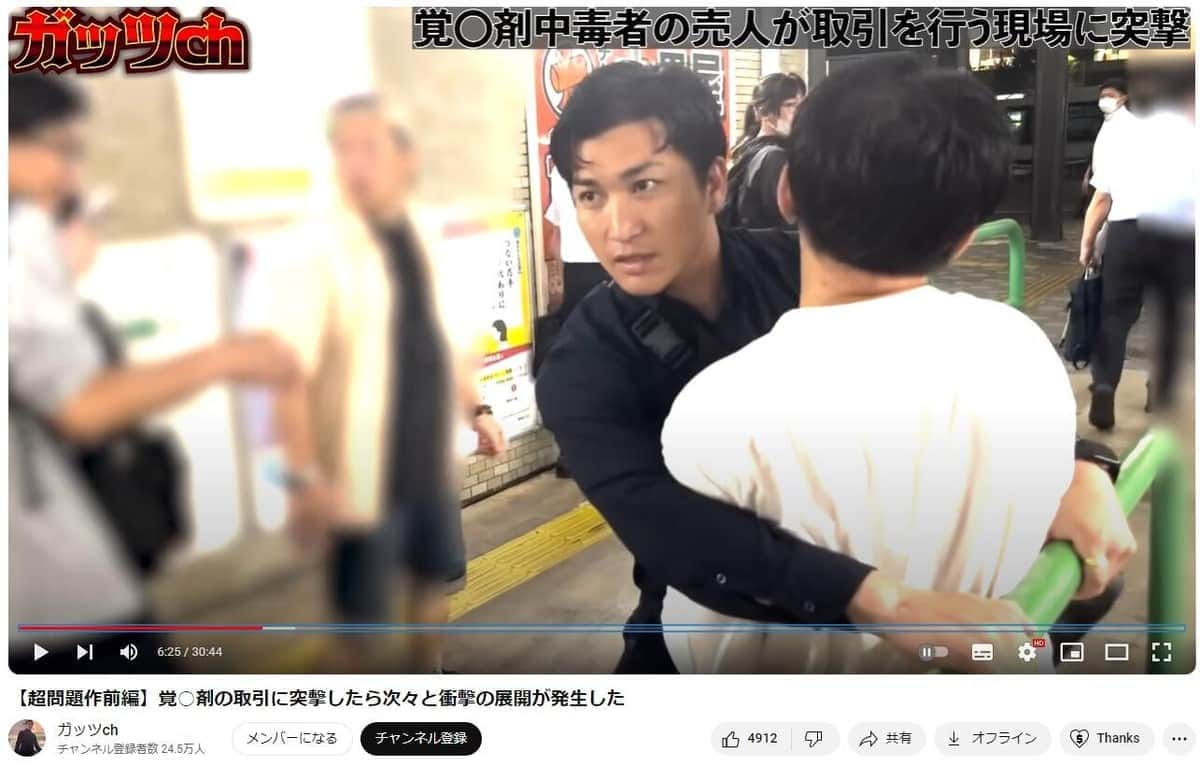
But the most infamous of the YouTube vigilantes is Konno Ren, who performed as Nakajima Ren. Konno had once been associated with an organized crime group in Kyushu but had changed his ways. He ran a channel called Guts ch, alongside his cameraman and partner Okumura Michitake. His case is the one that finally went to court and therefore the one we know best, because court records don’t lie the way a YouTube description box does.

Guts ch launched in January 2023, selling itself as an anti-groping, anti-voyeurism patrol. By September, it had 228,000 subscribers and, in a single five-month stretch, earned roughly sixty thousand dollars in revenue. Konno when interviewed certainly sounded like a man who believed his own copy. He told a television reporter that his single goal was the eradication of crime, that he was scrupulous about avoiding false accusations, and that when he laid hands on a man for groping or filming, he did so with total confidence.
Their downfall began when they decided to escalate and expand their business model to go after drug users. Whether shabu-using malcontents are really the worst people in society depends on your opinions about drug laws or your libertarian views.
Konno and Okumura went looking on social media for a man who’d posted about wanting methamphetamine (shabu--in Japanese slang. Because meth makes you thirsty, you tend to suck on candies or drink soda which is ‘shaburu’ in Japanese. Or it’s a reference to the fact that the drug will suck everything out of you).
After searching for junkies long enough, they found one, and had Konno pose online as a woman named “Yu” who wanted to use the drug during sex.
Why shabu and sex? Supposedly, and according to Japanese urban legends, meth makes sex better. They talked their mark into believing it, fed him enough insider slang about the drug to seem credible, and got him to go out and actually acquire 0.925 grams he hadn’t previously possessed—purely so he’d be holding it when he showed up to meet “Yu” on a Shinjuku street.
To continue reading for free, check out the rest of the article at Number 1 Shimbun, the Foreign Correspondents’ Club of Japan (FCCJ) monthly magazine.
